URGENT: A rare investing opportunity is taking shape as…
LITHIUM DAY
January 1, 2027: The Day the Lithium Market Changes Forever — Are You Positioned?
Africa’s largest lithium producer is about to ban all exports overnight. 7% of global supply — GONE by government decree.
Every tonne of that lost supply has to come from somewhere…
And AUSTRALIA’S lithium producers are some of the best-placed suppliers left standing…
When the market catches up to that, certain ASX lithium stocks could see a sharp re-rating. READ THIS FREE REPORT, AND CONSIDER BUYING THESE 4 STOCKS NOW…
Every major supply squeeze in history has minted fortunes for investors who moved before the catalyst — not after.
January 1, 2027 is a new catalyst.
It’s written into law.
And right now…most Australian investors have no idea it’s coming.
On January 1, 2027, Zimbabwe — Africa’s largest lithium producer — bans all export of lithium concentrate.
Not restricted. Not taxed. Not subject to negotiation.
Banned.
Eliminated by government decree. Overnight. With the stroke of a pen.
That's roughly 7% of global lithium supply — gone from world markets in a single legislative moment.
And here’s the part that should get every serious investor’s attention:
Zimbabwe didn’t even wait for the deadline.
On February 25, 2026, the Zimbabwean government suspended all exports of unprocessed minerals — including lithium-bearing concentrates — ahead of schedule, indefinitely, citing national interest.
They moved early. Without warning or apology.
The signal that sent to global commodity markets was unmistakable:
The era of cheap, freely traded lithium is over. And no amount of diplomatic pressure or market logic is going to reopen that door.
This isn’t just a mining story. It’s a story about supply, demand, and arithmetic.
You don’t need to own a resource stock to understand what’s about to happen.
You don’t need to follow commodity markets. You don’t need a broker who specialises in materials.
You just need to understand one of the oldest laws in economics:
When supply goes down and demand goes up, prices follow.
That’s not a prediction. It’s pure arithmetic.
And right now, both sides of that equation are moving in the same direction — simultaneously, and fast.
I outline the four best ways to play this, in a free report:
But to understand why this is vital investment intelligence right now in a noisy world…you need the underlying thesis.
Let’s start with supply — because it’s collapsing faster than anyone expected.
Zimbabwe is the most dramatic example.
But it’s not the only one.
CATL — the world’s largest battery maker — was forced to suspend its Jianxiawo mine in China’s Jiangxi province after its mining permit lapsed and regulators refused to fast-track renewal.
That single mine produces 46,000 tonnes a year of lithium carbonate equivalent.
Around 3% of global supply.
Lithium futures jumped the daily limit on the news.
The mine stayed shut for months.
Then, in December, authorities flagged another 27 permit cancellations across the same district.
By January 2026, Chinese lithium carbonate prices had already climbed 40% from the start of that year.
One permit. One province.
And the market’s ‘endless oversupply’ story started to unravel.
Meanwhile…
…on the other side of the world…
New mines that were supposed to flood the market with fresh supply are running years behind schedule.
Permitting delays. Community opposition. Financing gaps. Engineering blowouts.
What was supposed to be a five-year journey from discovery to production routinely stretches towards a decade.
The supply wave that was going to keep lithium cheap forever?
It isn’t coming.
Not on the timeline the market assumed.
Now let’s talk about demand…
Because it’s building from multiple directions.
All at once.
The Iran conflict has done something unexpected: it’s put a rocket under EV adoption.
Every time a driver fills up and sees the price on the bowser, the case for going electric gets stronger.
Governments are responding with tighter emissions standards and expanded EV incentives.
Automakers are accelerating their transition timelines.
EVs remain the foundation of lithium demand. But in 2026, they’re no longer the whole story.
Battery storage for electricity grids is now the fastest-growing piece of the market. Wind and solar farms need batteries to store what they generate.
AI data centres.
Which cannot tolerate even milliseconds of downtime…
…are increasingly deploying large lithium‑ion battery energy storage systems as mission‑critical backup and grid‑balancing infrastructure.
Then there’s the demand driver that barely existed three years ago.
And that much of the investment world still hasn’t fully priced in…
You’re sick of hearing about this guy. Stay with me anyway…
Elon Musk just became the world’s first trillionaire — at least on paper — after SpaceX listed on public markets in the largest IPO in history, bigger than Saudi Aramco’s.
But here’s what almost nobody is talking about — and it matters specifically to lithium investors in Australia:
SpaceX’s listing didn’t just mint a trillionaire.
It forced the world’s biggest institutional money — pension funds, sovereign wealth funds, the largest asset managers on the planet — to sit down and properly map out what Musk’s empire actually runs on.
Tesla’s production lines.
The Optimus robot program, moving from prototype towards mass deployment.
Starlink’s satellite fleet.
The AI compute now folded into SpaceX itself, following its merger with xAI.
And when that capital follows the thread all the way down, it keeps arriving at the same place:
Lithium
Not as a nice-to-have. As a structural requirement.
Tesla’s entire production model depends on it.
The Optimus robot program — now moving from prototype towards mass deployment — requires lithium battery packs at scale. Each unit. Every fleet. Compounding as the numbers grow.
Musk himself has projected a ratio of 20 to 30 billion robots worldwide over time.
Even if you discount that by 90%, you’re still looking at a demand number the current global supply chain has no capacity to meet.
That’s the picture institutional capital is waking up to post SpaceX IPO — with a company now valued at nearly $2 trillion, and the world’s first trillionaire as the headline act.
But here’s what makes this moment different from every other ‘Elon is bullish for lithium’ story you’ve read before. That demand surge is colliding with a supply shock that’s already locked in…
On January 1, 2027 — Lithium Day — 7% of global lithium supply disappears.
Put those two forces in the same room…and you get something rare:
The moment the world’s most-watched company just put a number on how much lithium the future needs — at the exact same time the world’s supply of it is about to shrink.
The SpaceX IPO isn’t the investment opportunity here.
Hardly any retail investors got a piece of that anyway.
It’s the spotlight — the moment that’s forced global capital to follow the thread and land on lithium, just months before that supply disappears.
And when that capital starts moving — ahead of Lithium Day — the best-positioned ASX stocks won’t be waiting for you to catch up.
Why I think this is the single- best opportunity window for far-sighted Aussie speculators in YEARS…
Let’s bring this all together.
On the supply side: Lithium Day is locked in.
China is cancelling mining permits.
New projects are running years behind schedule.
The ‘endless supply wave’ that crushed lithium prices from 2022 to 2024 has already peaked.
On the demand side: EV adoption is accelerating on the back of energy insecurity.
Grid storage is scaling rapidly.
AI data centres are becoming a new source of sustained lithium demand.
And the newly minted world’s first trillionaire just put a hard number on what a robot economy actually requires — at a scale most of the market still hasn’t priced in.
And as a catalyst: Lithium Day — a hard legislative deadline, already brought forward once, that will remove 7% of global supply from the market in a single moment.
Every major commodity squeeze in history has followed this pattern.
Supply tightens. Demand builds. A hard catalyst arrives. Prices move — fast, and often further than anyone predicted.
Position before Lithium Day, and you’re ahead of the re-rating. Wait, and you’re chasing it.
My name is Lachlann Tierney
I’m a senior equities analyst at Fat Tail Investment Research, specialising in Australian small-cap and micro-cap stocks in the critical minerals space.
I’ve spent eight years tracking the companies, the technologies and the supply chains that sit at the heart of the lithium market — long before it was popular, and through the long downturn when most investors walked away.
I hold a Master of Science from the London School of Economics and a PhD in economics from RMIT University.
I’ve been on record for a year calling this as lithium’s third and final major run before it becomes a mainstream industrial commodity.
Events since then have only strengthened that conviction.
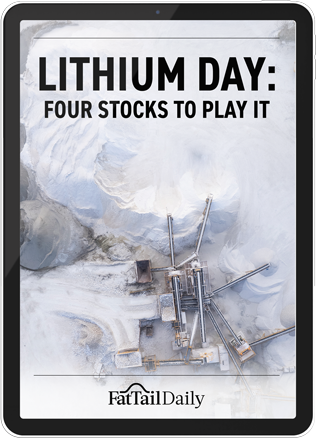
In my free report — ‘Lithium Day: Four Stocks to Play It’ — I’ve identified four companies across different lithium technologies and jurisdictions that I believe are best positioned for what’s coming.
You don’t need a mining background. You don’t need a specialist broker.
You just need a standard brokerage account and the willingness to act before the deadline arrives.
What you’ll discover in this free report:
What you’ll discover in this free report:
PLAY 1: A $41M DLE lithium developer in Canada — in one of the most mining-friendly jurisdictions in the world — positioned to feed North American demand as US supply chains are rebuilt from scratch.
PLAY 2: A lithium developer backed by Australia’s richest woman, producing zero-carbon lithium from geothermal brine in Europe — with signed offtake agreements from Stellantis, Volkswagen and Renault already in place.
PLAY 3: A Western Australian hard-rock developer sitting on 51.6 million tonnes of lithium resource, 100 kilometres from Kalgoorlie’s established infrastructure — with Mineral Resources as a strategic shareholder.
PLAY 4: A brine producer in Argentina’s highest-grade lithium region — pond construction is already underway, positioned for near-term production as the global squeeze tightens.
Access to the free report, ‘Lithium Day: Four Stocks to Play It’, is FREE when you subscribe to Fat Tail Daily and James Cooper’s Mining Memo.
Enter your email address below and hit the button to gain instant access.
These Terms and Conditions apply to your use of and subscription to Fat Tail Investment Research (FTIR) publications and its websites. By using our services you agree to be bound by these Terms and Conditions and they shall constitute an agreement between you and Fat Tail Investment Research Pty Ltd (‘FTIR’, ‘us’, ‘our’, ‘we’).
We are licensed to provide general financial product advice only to retail and wholesale clients on:
Deposit and payment products limited to:
(a) basic deposit products; and
(b) deposit products other than basic products.
Interests in managed investment schemes, including investor directed portfolio services.
Investment life insurance products as well as any products issued by a Registered Life Insurance Company that are backed by one or more of its statutory funds.
Life risk insurance products as well as any products issued by a Registered Life Insurance Company that are backed by one or more of its statutory funds.
By agreeing to these Terms and Conditions you acknowledge you have read and understood our Financial Services Guide.
All information contained on our websites (our websites include any website that is operated by us and offers one or more publications that we publish) and in emails and other electronic services is general advice; your personal circumstances have not been taken into account. If you’re in doubt about the suitability of an investment, it is a good idea to seek professional financial advice.
Access to Information
Users will only have access to the services they are subscribed to. For paid services, only a paying member has access to the subscriber-only section of our websites and emails. Subscribers must not reveal any username(s) or password(s) or forward paid services emails to any third party. The free e-letters can be viewed on their dedicated websites or subscribed to by email.
Use of Copyrighted Material
All material published on our websites is owned or provided under licence by FTIR. Content in the free e-letters may be republished only if you acknowledge the e-letter as the source and provide a link to its dedicated website. Content in our paid subscriptions is not to be reproduced, forwarded or disclosed without our prior written permission.
Privacy
When you provide personal information to FTIR you agree to the terms of our Privacy Policy. Please read our Privacy Policy.
Security Policy and Our Services
When purchasing from FTIR your financial details are passed through a secure server using the latest 128-bit SSL (Secure Sockets Layer) encryption technology. 128-bit SSL encryption is the industry standard, however FTIR does not warrant or represent that it provides a totally secure online service. If you have any questions regarding our security policy, please contact our customer services team at support@fattail.com.au.
Given the nature of electronic and telecommunications services and the fact that FTIR does not own, operate or control these systems, FTIR does not promise to make its subscriptions and other online and electronic services and offerings continuously available or virus- or fault-free. Likewise, we do not promise to make any of our services available by a particular time or method.
Information, opinions, comments and reports have been produced in good faith and based on information collected from a wide range of sources believed to be correct and accurate at the time of publication. FTIR exercises due care in the research, preparation and delivery of its services. However, we do not represent or warrant that any service or content we provide is accurate, reliable, suitable, complete or of a particular quality.
Our Liability to You
Except as expressly required by legislation, we accept no liability to you (including, without limitation, by way of negligence) arising from the provision (or non-provision as the case may be) of any of our services. To the extent permitted by legislation, any liability we may have to you is limited to the resupply of services or refund of any unused portion of your annual subscription (where relevant).
None of FTIR and its employees, directors, agents or associates guarantees the performance of any security or other financial product (or class of financial product) that is reviewed, recommended or opined on in any of our services. We strongly recommend you make your own inquiries and seek professional advice before making any investment decisions.
Cancellation Policy, Pricing and Trial Periods
We reserve the right to refuse subscription. When you subscribe to a FTIR publication you enter into a continuing agreement for that publication, which is charged either yearly, quarterly, or monthly (‘the subscription period’), or as otherwise specified, depending on the offer agreed to.
Each subscription period must be paid for in full prior to starting the subscription period. We will cancel your subscription if the subscription period is not paid in advance, or if you give us written notice that you wish to cancel.
The prices for new subscriptions will be communicated to you prior to subscribing. Membership of FTIR Alliance services is non-refundable after the first 30 days of your confirmed subscription. Our standard pricing is contained in our Financial Services Guide.
Each newsletter may offer a trial period for new subscribers only. If you have subscribed to a newsletter previously and ceased your subscription for any reason, you will not be entitled to another trial period should you decide to resubscribe at a later date. A person deemed to be abusing the trial period feature may be refused subscription to other FTIR products or services. Subscription fees must be paid in full before subscribing. Should you cancel within the trial period (where a trial period is offered) you will receive a full refund unless otherwise stated.
We can review and alter our prices for any subscription period at any time. Any changes to pricing for existing subscribers will take effect when your next subscription period starts. If the price for your next subscription period is to increase we will let you know before it changes.
All prices are quoted in Australian dollars and include any postage.
Refund Policy
If there is a problem with your subscription FTIR will attempt to fix the problem in so far as the problem is within our control. Where the minor problem can’t be fixed within a reasonable time you have the right to cancel the subscription and a refund will be provided for the part of the subscription period that the service was unavailable to you.
We will provide a refund where there is a major issue with our service, such as:
we have provided the service with an unacceptable level of care and skill;
the subscription is not fit for the purpose described by us; or
the subscription is not delivered by the agreed date or within a reasonable time.
We will also consider refunds where there are problems that arise with the subscription that are within our control, for example:
if our files are corrupt; or
we are unable to deliver content in accordance with your subscription terms; or
we are suffering technological problems.
We do not provide refunds for a change of mind, or in circumstances where the problem is outside of our control, such as:
problems with your internet service provider;
technology problems arising from your devices; or
network outages.
Refunds will be issued where applicable on a pro rata basis to the value of the part of the subscription period that has been affected, and will not be provided in situations where content was accessible, even if the content was not accessed by you.
From time to time, FTIR may provide an alternative refund policy for certain newsletters and for a certain period. Details of any applicable refund policy will be made clear at the point of sale. Otherwise, this standard refund policy applies. In circumstances where a refund has been issued, please allow up to 28 days to receive your funds. If you have not received your funds within that time, please contact our customer service team.
Lifetime Subscriptions
Lifetime subscriptions entitle paid subscribers to access to a particular service for as long as the service is published, as long as the applicable maintenance fee is paid. In the rare event where FTIR ceases publication of the particular service, we will always endeavour to replace it with a similar product, at no additional cost to you.
Discounted Introductory Offers
If you have subscribed to a particular service at a discounted introductory price (i.e. a promotional offer for new subscribers), you may not be entitled to similar offers in future relating to the same service.
Portfolio Performance and Returns on Stocks
All returns are hypothetical and based on the percentage change between the stock price at the time of recommendation and sell price or current price (if position is still open). Brokerage and any other associated costs are not taken into account.
Individual subscribers’ returns may vary from our recorded returns, depending on entry and exit dates.
Unlawful Activity
FTIR has the right to investigate any breach or complaint about a violation of these terms and conditions. FTIR will take any necessary action to protect itself and may report any unlawful activity to the relevant legal authorities.
Breaching the Terms and Conditions and Cancellation
Any subscriber or website user found to be in breach of these Terms and Conditions may have their subscription or website access suspended, amended or cancelled. We reserve our right to take whatever action is available to us under the law.
We reserve the right to cancel any subscription at any time, for any reason, regardless of whether a breach of these terms and conditions has occurred. Where we cancel your subscription, the unused portion of your subscription will be refunded on a pro rata basis.
Changes to These Terms and Conditions
We may change all or part of these Terms and Conditions at any time. If we do, the new Terms and Conditions will be posted on our websites. Your subsequent or continued use of our websites and/or receipt of our emails will constitute your acceptance of any changes. If you object to any changes to the Terms and Conditions, your only remedy is to discontinue your use of the website or cancel your subscription with us. As you are bound by these Terms and Conditions, we recommend that you periodically refer to them.
If you have any queries relating to these Terms and Conditions please contact our customer service department. Please email support@fattail.com.au or phone 1300 667 481. Or you can write to us at 387 City Rd, South Melbourne, VIC 3205.
Fat Tail Investment Research takes individuals’ privacy very seriously. We are also aware of the potential for threats to your security and privacy. Please take a few moments to review the steps that Fat Tail Investment Research takes to ensure your privacy and security while you are using our websites.
Our privacy policy outlines how we collect and handle your personal information. References to ‘FTIR’, ‘we’, ‘our’ and ‘us’ refer to Fat Tail Investment Research and its related companies.
How and what personal information we collect
We collect your personal information (including your address, contact details, and credit card details) only when you place an order with us or when you contact us about your subscription or our other services. When you place an order, we will provide a secure (SSL, encrypted) connection and require you to submit only the information needed to complete and fulfil your order. This may include, but is not limited to, your name, credit card details, email address, postal address and phone number. Only our authorised employees will have access to this information.
You can update your personal information by contacting us.
How we use cookies
Cookies are small files placed on your computer by a web page when you visit it. They can be used to store all sorts of useful information to make your next visit easier and more convenient, but some people are uncomfortable not knowing what information is in a cookie.
The FTIR website uses cookies to compile statistics on the use of the various pages on our site and provide a unique user experience by tailoring which advertisements you see. From time to time we may use data collected from cookies to customise products and services we may offer you. When we send you emails, we include a ‘web beacon’ to allow us to determine the number of people who open our emails. When you click on a link in an email, we may record this individual response to allow us to customise our offerings to you. Web beacons collect only limited information, such as a cookie identifier, time and date of a page being viewed, and a description of the page on which the web beacon resides (i.e. the URL).
Web beacons can be refused when delivered via email. If you do not wish to receive web beacons via email, you will need to disable HTML images or refuse HTML emails (choose to receive ‘text only’ emails) via your email software.
When we send you emails we may also include tracking that identifies what marketing material you watch or read. This tracking makes you personally identifiable since we use your email address.
How we use your personal information
Your personal information may be used to:
verify your identity when we are speaking with you;
assist you to subscribe to our services and products;
administer and manage our services, including charging and billing;
research and develop our services; and
promote and market services and products to you (where we do so, we will always give you an opportunity to let us know if you do not wish to receive marketing and promotions from us).
If some or all of the personal information we require is not collected, we may be unable to efficiently provide you with the services you require.
Who can access your personal information
Only authorised employees of FTIR have access to any information you provide. We may turn over any pertinent information to any legal or regulatory authority that has a demonstrable right and takes the proper steps to access it. We may also, if necessary, provide your personal information to our lawyers, accountants, auditors and other third parties (such as, but not limited to, IT providers) who provide services to us or act on our behalf, for the purposes of giving effect to the services you request from us, to improve support and provide a better, more relevant experience for you, or as necessary to conduct our business.
Where your personal information is disclosed, it is provided by secure, encrypted email to reputable third parties andwe will ensure that the information is to be held, used or disclosed consistent with the Australian Privacy Principles.
If you inquire about one of your subscriptions, we may ask you to submit some additional information only to verify your identity. Remember, in this case we only ask you to confirm information you have already given us.
You have the right to contact us and ask what information we may hold about you. Before you can obtain access to any information about you that FTIR holds, your identity will first need to be verified. A fee may apply for such access.
What if some of the information held is incorrect?
We endeavour to keep all information about you current. If any information we hold is incorrect please contact us.
Consent to use and disclosure of your personal information
FTIR is a member of the Agora Inc global network of companies, which is headquartered in Baltimore, Maryland, USA. By subscribing to a FTIR service you consent to being sent news and offers related to your subscription, or that may suit your interests, by FTIR, related companies and carefully selected organisations. On occasion, FTIR may provide your mailing address to third parties for direct marketing purposes. If at any time you do not wish your mailing address to be used for direct marketing or receive news and offers from carefully selected organisations, please contact FTIR directly by email, post or phone. It is a requirement that all newsletters, updates and special reports are sent electronically. If you no longer wish to receive these services you may cancel your subscription at any time.
We may occasionally send you marketing emails. Our email marketing is permission-based. If you receive an email from us, it is because you are a subscriber or have otherwise consented to the terms of this Privacy Policy. You may unsubscribe at any time by post, by phone, or by clicking the unsubscribe link at the bottom of each email. We do not rent or sell email addresses to companies outside of FTIR.
Personal information and data security
Your data is stored on our behalf on Agora Inc’s databases and servers located in the US, so it is necessary to disclose your personal information to Agora Inc for this purpose. FTIR ensures all data collected is protected and secure against unauthorised access, alteration or deletion. Any data you submit to us through an online order form is transferred to us via a Secure Sockets Layer (SSL) encryption protocol and is kept in databases that cannot be accessed from outside our firewall. Our firewall is a mechanism that prevents access to our servers by anyone outside of the company.
The FTIR website and emails may contain links to third party websites. Should you choose to click these links please be aware that our privacy policy will no longer apply. Please read and understand the privacy policy of the third party website before continuing further.
Google analytics
Where users have chosen to enable Google to associate their web and app browsing history with their Google account, and to use information from their Google account to personalise ads, Google will use data from its signed-in users together with their Google Analytics data to build audience lists for cross-device remarketing.
Google Analytics will collect Google-authenticated identifiers associated with users’ Google accounts and will temporarily join these identifiers to the Google Analytics data made available to FTIR.
Please note that all Google users can control their ad experience (or opt out of personalised ads altogether) at My Account.
Updates to our privacy policy
FTIR will review and update this privacy policy as needed. Please check back regularly for any updates.
Privacy concerns or complaints
If you have concerns or wish to make a complaint regarding our handling of your personal information, please contact us. We will promptly investigate your complaint and notify you of the outcome. If you are still not satisfied with the outcome of your complaint, you may in some cases refer your complaint to the Australian Financial Complaints Authority (phone 1800 931 678, or online at afca.org.au), or the Office of the Australian Information Commissioner (phone 1300 363 992, or online at oaic.gov.au).
How to contact us
If you have any questions regarding our privacy policy you can reach us here:
Fat Tail Investment Research Pty Ltd,
387 City Rd, South Melbourne, VIC 3205
Our registered address is:
Fat Tail Investment Research Pty Ltd,
387 City Rd,
South Melbourne, VIC 3205
Australia
Copyright Fat Tail Investment Research Pty Ltd. All rights reserved. No portion of this document may be reproduced, copied or in reused any way without the written permission of Fat Tail Investment Research.